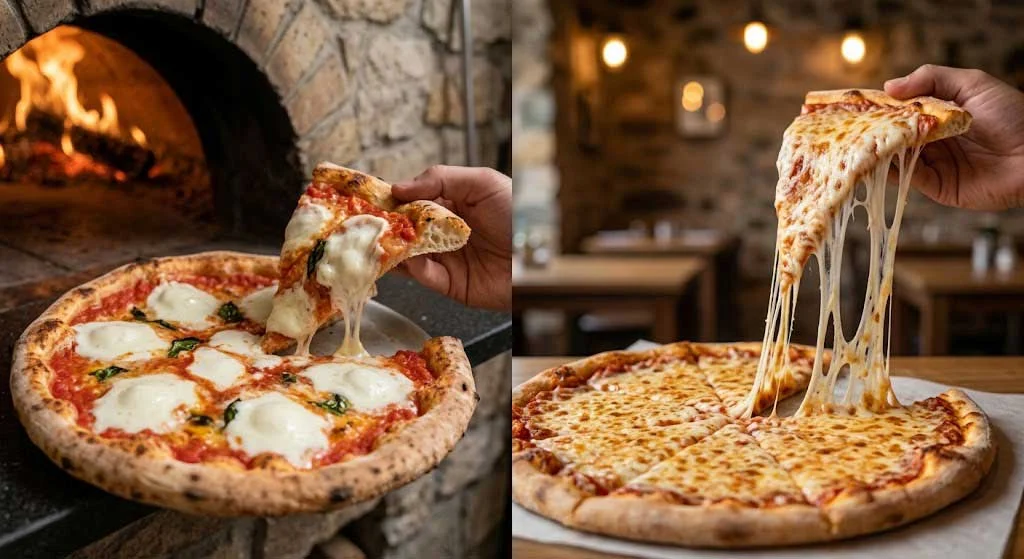
When choosing cheese for pizza, two names appear again and again: mozzarella and pizza cheese. Although they are often used interchangeably, they are not always the same product.
Understanding the difference can help restaurants, foodservice businesses, manufacturers, and consumers choose the right cheese for the texture, melting behavior, flavor, and performance they expect from a pizza.
What Is Mozzarella?
Mozzarella is a traditional cheese known for its mild flavor, soft texture, and excellent melting characteristics.
It is commonly associated with pizza because it can melt evenly and develop the characteristic stretch that many people expect from a high-quality pizza.
Depending on the type and formulation, mozzarella can vary in moisture, fat content, texture, melting behavior, and flavor.
For pizza applications, these characteristics are especially important because the cheese needs to perform well under high oven temperatures while maintaining an appealing appearance and texture.
What Is Pizza Cheese?
“Pizza cheese” is a broader term used for cheeses or cheese formulations specifically designed for pizza applications.
Unlike mozzarella, which refers to a particular family of cheese, pizza cheese can be formulated to achieve specific functional characteristics such as:
- Consistent melting
- Good stretchability
- Controlled browning
- Even coverage
- Suitable oil release
- Stable performance during baking
- Consistent performance in commercial foodservice
Depending on the product, pizza cheese may be based on mozzarella, a blend of cheeses, or a specially developed formulation.
This means that not every pizza cheese is simply mozzarella, and not every mozzarella is optimized for every pizza application.
The Main Difference
The simplest way to understand the difference is this:
Mozzarella describes a type of cheese, while pizza cheese describes a cheese product designed around the requirements of pizza.
Mozzarella can be an excellent pizza cheese. In fact, mozzarella is one of the most widely used cheeses for pizza.
However, when pizza is produced at commercial scale, other factors become increasingly important. Restaurants and food manufacturers may need predictable melting, controlled browning, consistent stretching, and stable performance from one batch to another.
This is where a purpose-designed pizza cheese can offer advantages.
Melting Performance
One of the most important characteristics of pizza cheese is how it behaves during baking.
A suitable pizza cheese should melt evenly across the surface of the pizza without producing excessive separation or undesirable texture.
The ideal melting behavior depends on several factors, including the formulation, moisture, fat, protein structure, processing conditions, and baking temperature.
For commercial applications, consistency is particularly important. A cheese that performs differently from one production batch to another can affect the final appearance and quality of the pizza.
Stretch and Texture
The familiar cheese stretch is another important characteristic.
Mozzarella is well known for its ability to create stretch after melting. However, the amount and type of stretch can vary depending on the cheese’s composition and processing.
Pizza cheese can be formulated to provide a specific balance between stretch, bite, softness, and structure according to the intended application.
For example, a foodservice product may require a different texture and melt profile from a cheese intended for frozen pizza.
Browning and Appearance
Cheese doesn’t only affect the texture of a pizza—it also contributes significantly to its appearance.
During baking, cheese can develop golden-brown areas that contribute to the visual appeal of the finished pizza.
The level and speed of browning can depend on the formulation and baking conditions.
For commercial pizza production, controlled browning can be important because manufacturers and foodservice operators often want a consistent appearance across products.
Which One Is Better for Pizza?
There is no single answer.
Mozzarella can be an excellent choice when its characteristics match the desired pizza style and application.
Pizza cheese may be preferable when specific performance characteristics and consistency are required.
The right choice depends on factors such as:
- Pizza style
- Baking temperature
- Baking time
- Fresh or frozen application
- Desired stretch
- Desired browning
- Texture
- Flavor profile
- Production scale
- Storage and handling requirements
Why Does the Difference Matter for Businesses?
For a home cook, the distinction may not always be significant.
For a restaurant, distributor, or food manufacturer, however, cheese performance can have a direct effect on the final product.
A commercial pizza cheese needs to perform consistently—not just once, but across repeated production cycles.
That means choosing cheese based on functionality, consistency, and application, rather than simply choosing a cheese by name.
The 9595 Perspective
At 9595, product development begins with understanding the requirements of the final application.
Pizza cheese is not simply an ingredient added to a pizza. Its melting, stretching, texture, appearance, and overall performance all contribute to the final product.
Through food technology and product development, the goal is to create formulations that deliver consistent performance while meeting the specific requirements of different food applications.
Final Takeaway
Mozzarella and pizza cheese are closely related, but they should not always be treated as identical.
Mozzarella is a type of cheese. Pizza cheese is a broader category focused on performance in pizza applications.
For the best result, the important question is not simply “Is this mozzarella?” but rather:
“Does this cheese deliver the performance my pizza application requires?”
Understanding that distinction can help both consumers and food professionals make better decisions when selecting cheese for pizza.